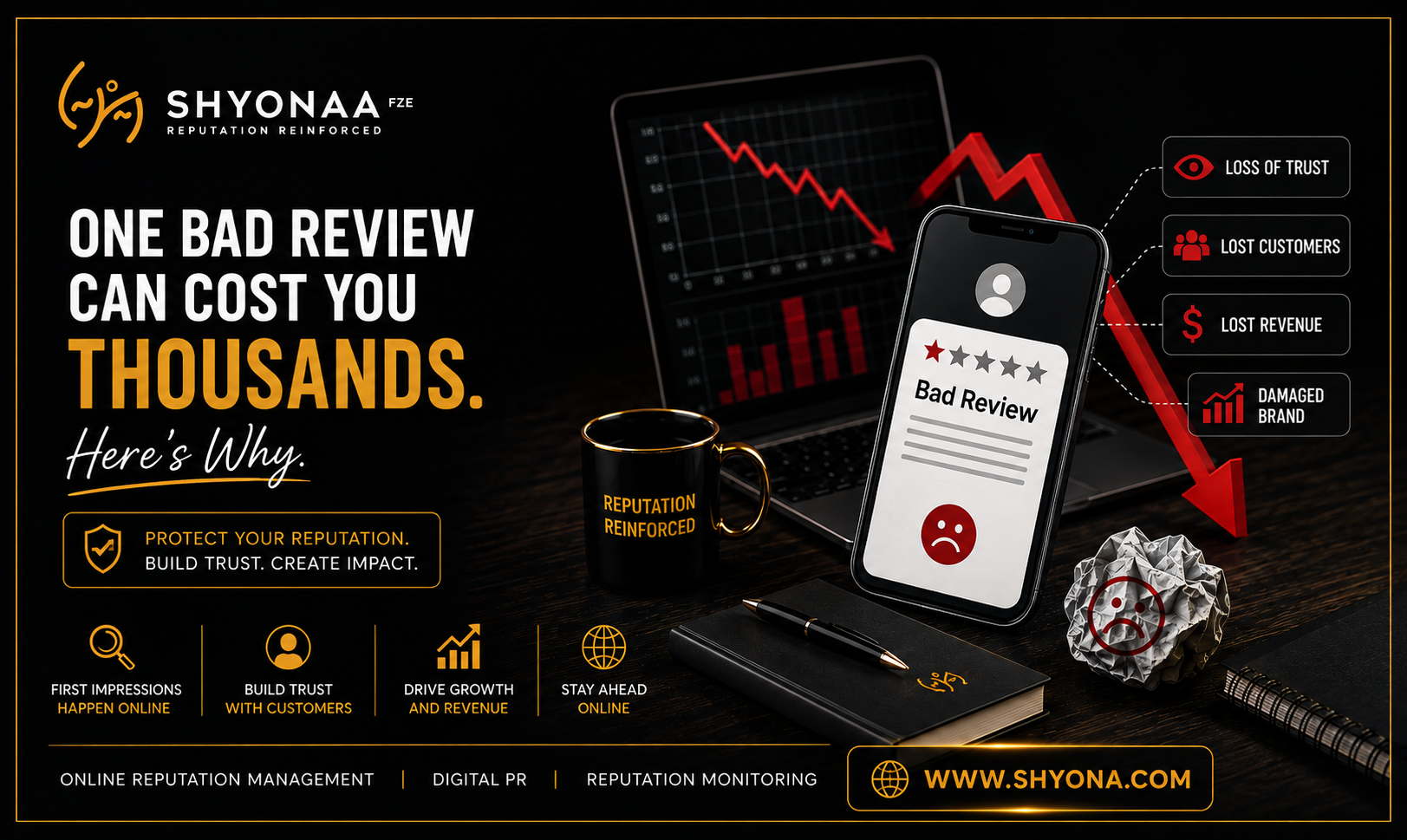
A potential customer discovers your business.
They like what they see. Your services look right, your website looks professional, and they are almost ready to contact you.
Then they Google your name.
A negative review appears.
They hesitate.
They read another comment, check your rating, compare you with a competitor — and quietly move on.
You may never know why you lost that customer.
That is the real cost of a negative online reputation.
In today’s digital world, your reputation is often working before your sales team gets the opportunity to speak. What appears on Google can influence whether someone trusts your business, contacts you, recommends you, or chooses somebody else.
Your Reputation Is Selling Your Business Before You Do
Google has become part of the decision-making process.
Before contacting a company, booking a service, applying for a job, investing in a business, or entering into a partnership, people increasingly research the people and organizations involved.
They may look at:
- Google reviews
- Search results
- News articles and media coverage
- Social media profiles
- Business listings
- Your website
- LinkedIn profiles
- Forums and discussion platforms
- Other third-party content
Together, these results create a digital first impression.
A strong online reputation can reinforce credibility. A poor or unmanaged reputation can introduce doubt at exactly the moment somebody is deciding whether to trust you.
One Negative Review Can Have a Bigger Impact Than You Think
Not every negative review will damage a business.
Customers understand that no company is perfect, and a balanced review profile can even appear more authentic.
The problem begins when negative reviews become unusually prominent, contain misleading information, appear repeatedly, or start defining the overall online narrative around a business.
For companies operating in competitive markets such as Dubai, even a small amount of damaging content can become important when customers are comparing several businesses offering similar services.
The impact can extend beyond sales.
An unmanaged online reputation can potentially affect:
Customer enquiries
prospects may choose a competitor before contacting you.
Business partnerships
potential partners may research your company before starting a relationship.
Recruitment
candidates often research employers before accepting an opportunity.
Investor confidence
executives, founders and businesses are frequently researched during due diligence.
Media credibility
journalists and industry professionals may examine your digital footprint before referencing your business.
Referrals
even referred customers may Google you before making a decision.
This is why reputation management is no longer simply about maintaining a good star rating.
It is about managing the broader digital picture people encounter when they search for you.
Reputation Is Bigger Than Google Reviews
Google reviews are important, but they represent only one part of your online reputation.
A company’s digital reputation can include:
- Search-engine results
- Customer reviews
- News and media coverage
- Social media conversations
- Executive profiles
- Business directories
- Blogs and articles
- Videos
- Images
- Forums
- Third-party websites
This is where Online Reputation Management (ORM) becomes important.
ORM looks at the entire search and digital ecosystem rather than treating an individual review as an isolated problem.
The objective is to understand what people find, assess which content is affecting perception, address legitimate reputation issues, and strengthen the credible digital assets that accurately represent the business.
Can Negative Google Reviews Be Removed?
This is one of the most common questions businesses ask.
The important distinction is that a business cannot simply delete a Google review because it is negative.
A legitimate customer expressing a genuine negative opinion will not normally qualify for removal simply because the business disagrees with it.
However, reviews that violate Google’s policies may be eligible to be reported and reviewed for removal.
This distinction matters.
Professional reputation management should never begin with the assumption that every negative review can or should disappear. The first step is determining whether the content potentially violates platform policies and deciding on the appropriate response.
What Types of Google Reviews May Be Eligible for Removal?
Google maintains policies governing prohibited and restricted content. Depending on the circumstances, reviews containing certain types of policy violations may be eligible to be reported.
Examples can include:
Fake or Spam Reviews
Reviews that do not represent a genuine experience, are posted to manipulate ratings, or form part of coordinated spam activity may potentially violate Google’s policies.
Conflict-of-Interest Reviews
Content designed to manipulate a company’s reputation rather than describe a genuine experience may warrant closer examination, particularly where there is evidence of a conflict of interest.
Harassment or Offensive Content
Reviews containing prohibited harassment, threats, hateful material or other inappropriate content may violate Google’s content policies.
Irrelevant or Off-Topic Content
A Google review should relate to an experience with the relevant business or location. Content unrelated to the business may potentially be reportable.
Impersonation or Misrepresentation
Content involving impersonation or misleading representation may also fall within Google’s prohibited-content policies.
Reviews Posted Against the Wrong Business
Sometimes customers mistakenly leave feedback on the wrong business profile. These situations should be assessed carefully and addressed through the appropriate platform process.
Eligibility for removal depends on the actual content and circumstances. Removal should never be guaranteed simply because a review is damaging or unwanted.
How Do You Report a Google Review?
If you believe a review violates Google’s policies, it can be reported through the appropriate Google Business Profile or review-reporting process.
Before reporting it, document the issue carefully.
Consider:
- What specific policy might the review violate?
- Is there evidence supporting the report?
- Does the reviewer appear to have interacted with the business?
- Is the content actually prohibited, or is it simply a negative opinion?
- Are there patterns suggesting spam or coordinated activity?
A clear, evidence-based assessment is considerably stronger than reporting every negative review indiscriminately.
After a review is reported, Google determines whether the content violates its policies.
Reporting a review does not guarantee that Google will remove it.
What If Google Doesn’t Remove the Negative Review?
This is where a broader reputation-management strategy becomes important.
If a review does not violate Google’s policies, or Google decides not to remove it, businesses still have several legitimate options.
Respond Professionally
A thoughtful response demonstrates that the company listens to feedback and takes customer concerns seriously.
The response is not only for the reviewer.
Future customers may read it too.
Avoid emotional arguments, accusations, threats or revealing confidential customer information.
Investigate the Complaint
If the review reflects a genuine customer experience, determine whether there is a legitimate operational issue behind it.Sometimes the most effective reputation strategy starts offline.
Encourage Genuine Customer Feedback
Businesses can build a healthier review profile by making it easier for genuine customers to share their experiences.
The objective should be authentic feedback — not fabricated reviews or manipulation of ratings.
Strengthen Positive Digital Assets
A negative review becomes more influential when there is little other credible information available about the business.
Strong websites, authoritative articles, media coverage, executive profiles, social platforms and other legitimate digital assets can help create a more complete picture.
Use SEO and Digital PR Strategically
When damaging search results extend beyond Google reviews, SEO, content strategy and Digital PR can help strengthen authoritative and relevant information across the search landscape.
This is where reputation management becomes much broader than review management.
Review Removal vs. Search Result Suppression
These are often confused, but they are not the same thing.
Review removal involves reporting content to a platform when there is a legitimate basis to believe it violates that platform’s policies.
Search result suppression, sometimes called push-down, is an ORM strategy aimed at strengthening relevant and credible digital assets so that damaging or outdated search results become less prominent over time.
Suppression does not mean deleting information from the internet.
It involves building and optimizing legitimate content that better represents the person or business.
Depending on the situation, an ORM strategy may involve one or both approaches.
Why Negative Review Management Matters for Dubai Businesses
Dubai is an extremely competitive and digitally connected business environment.
Consumers, investors, tourists, professionals and potential business partners frequently research companies online before making decisions.
This makes reputation particularly important for industries such as:
- Real estate and property development
- Hospitality
- Restaurants
- Healthcare
- Professional services
- Financial and business services
- Retail
- Luxury brands
- Technology
- Consultants and entrepreneurs
When several businesses offer comparable services, online credibility can become an important differentiator.
For Dubai businesses, reputation management should therefore be treated as an ongoing business function rather than something addressed only after a crisis occurs.
Don’t Wait for a Reputation Crisis
One of the biggest mistakes businesses make is waiting until negative content begins affecting enquiries before paying attention to their online reputation.
By that stage, the business may already be reacting defensively.
A stronger approach is proactive.
Monitor what appears when people search for your company.
Understand customer sentiment.
Maintain accurate business profiles.
Respond professionally to legitimate criticism.
Build credible content.
Earn authoritative media visibility.
Strengthen your website and search presence.
And regularly assess whether the digital version of your company accurately reflects the business you have built offline.
This Is Where SHYONA Makes the Difference
At SHYONA, we approach reputation management as more than removing negative content.
We look at the complete digital landscape surrounding a business or individual — what appears in search, what customers are saying, which content is gaining visibility, and where credibility can be strengthened.
Our Online Reputation Management strategies may include:
- Online reputation assessment and monitoring
- Review analysis and management
- Assessment of potentially policy-violating content
- Search-result management
- Negative-content suppression strategies
- SEO
- Digital PR
- Positive content development
- Executive and personal reputation management
- Business reputation management
- Ongoing reputation monitoring
Every reputation situation is different.
Some cases involve reviews. Others involve outdated search results, misleading content, negative media coverage, weak digital authority, or simply an absence of credible information.
That is why an effective ORM strategy should be tailored to the specific reputation challenge rather than relying on a one-size-fits-all solution.
Protect the Reputation You’ve Worked to Build
Your online reputation is not separate from your business anymore.
It can influence who calls you, who trusts you, who works with you, and who chooses your competitor.
One negative review may not destroy a strong business.
But an unmanaged digital reputation can quietly influence decisions every day.
The businesses that understand this don’t wait for a crisis.
They build, protect and strengthen their reputation continuously.
SHYONA helps businesses, founders, executives and individuals build and protect credible online reputations through strategic Online Reputation Management, Digital PR and SEO.
Frequently Asked Questions
Can a business delete a negative Google review?
Businesses generally cannot directly delete customer reviews simply because they are negative. Reviews that potentially violate Google’s policies can be reported to Google for assessment.
Can fake Google reviews be removed?
Potentially. If a review is fake, spam, misleading, or otherwise violates Google’s policies, it may be eligible to be reported. Google ultimately determines whether the review should be removed.
How long does Google review removal take?
There is no universal guaranteed timeframe. Review and enforcement times can vary depending on the content, circumstances, platform assessment and whether additional review or escalation is required.
What happens if Google doesn’t remove a negative review?
Businesses can respond professionally, investigate legitimate customer concerns, encourage authentic customer feedback and use broader ORM, SEO, content and Digital PR strategies to strengthen their overall online presence.
Can an ORM company guarantee removal of a Google review?
No reputable ORM strategy should guarantee that every negative Google review can be removed. Removal ultimately depends on the platform’s policies, the circumstances of the review and Google’s decision.
How can businesses in Dubai protect their online reputation?
Businesses should actively monitor reviews and search results, respond appropriately to customer feedback, maintain accurate digital profiles, publish credible content, strengthen SEO, build authoritative media visibility and address potentially harmful content through legitimate processes.